





Bidirectional Inverter vs Traditional Inverter: Key Differences
- Overview of inverter architectures and roles
- What a traditional (unidirectional) inverter does
- What a bidirectional inverter adds
- Architectural categories
- Bidirectional vs traditional: technical differences
- Power flow and control complexity
- Efficiency and thermal considerations
- Grid and safety standards
- Applications, economics and real-world trade-offs
- Use cases that favor bidirectional inverters
- When a traditional inverter remains appropriate
- Cost-benefit and lifecycle considerations
- Selecting the right inverter and manufacturer
- Key selection criteria
- Manufacturer profile: Guangzhou Congsin Electronic Technology Co., Ltd.
- Practical guidance for procurement and integration
- Technical comparison table: typical differences at a glance
- FAQs
- 1. What is the main advantage of a bidirectional inverter?
- 2. Are bidirectional inverters less efficient than traditional inverters?
- 3. Can a bidirectional inverter be used with any battery chemistry?
- 4. Do bidirectional inverters comply with grid codes?
- 5. Is vehicle-to-grid (V2G) possible with residential bidirectional inverters?
- 6. How should I decide between AC-coupled and DC-coupled (bidirectional) architectures?
- Contact and next steps
- References
Bidirectional inverter technology is reshaping how distributed energy systems manage power flow, enabling energy to move both from DC sources (batteries, PV) to AC loads and back from AC to DC sources for charging or grid-interactive services. For companies, system integrators and end users choosing between a bidirectional inverter and a traditional inverter, the decision affects system architecture, cost, efficiency and long-term flexibility. This article clarifies the differences, trade-offs and selection criteria so you can match device capabilities to project objectives and regulatory environments.
Overview of inverter architectures and roles
What a traditional (unidirectional) inverter does
Traditional inverters convert DC power to AC power (DC→AC). Typical applications include solar string inverters, portable power inverters and many grid-tied inverter systems where the energy flows primarily from DC generation or storage to AC loads or the grid. They are optimized for high-efficiency DC→AC conversion and grid synchronization, and commonly implement anti-islanding, over/under voltage protection and maximum power point tracking (MPPT) for PV systems. For basic background on inverter functions see the Wikipedia inverter page.
What a bidirectional inverter adds
A bidirectional inverter performs both DC→AC and AC→DC conversions under controlled conditions. This allows the same hardware to convert battery energy to AC for loads and to convert AC (from the grid or a generator) into DC to charge batteries. Key use cases include solar+storage systems, battery backup with automatic charging, vehicle-to-grid (V2G) or vehicle-to-home (V2H) services, and advanced microgrid controls. The bidirectional capability enables reversible power flow, energy arbitrage, frequency regulation and peak shaving.
Architectural categories
Common architectures include: (1) Single-stage grid-tied bidirectional inverters with internal DC coupling for batteries and PV, (2) Hybrid inverters that combine MPPT for PV with charge/discharge control for batteries, and (3) AC-coupled systems where an external battery inverter handles AC→DC while PV feeds a separate PV inverter. Choice depends on system efficiency, control granularity and upgradeability.
Bidirectional vs traditional: technical differences
Power flow and control complexity
Bidirectional inverters require more sophisticated control firmware and power electronics to manage seamless transitions between charging and discharging, handle regenerative current limits, and coordinate with grid codes for reactive power and anti-islanding. Traditional inverters focus on one direction and therefore have simpler state machines. In applications like uninterruptible power supplies (UPS) or V2G, the bidirectional device must also support fast detection and switching to avoid supply interruptions.
Efficiency and thermal considerations
Both types present conversion losses, typically expressed as round-trip efficiency for systems with batteries. Bidirectional inverters often display slightly lower single-path DC→AC peak efficiency than optimized unidirectional inverters due to additional switching stages and protective circuitry, but offer superior system-level round-trip efficiency compared to architectures that require multiple independent converters. Typical commercially available figures (dependent on topology and rating) are:
| Metric | Traditional inverter (typical) | Bidirectional inverter (typical) |
|---|---|---|
| DC→AC peak efficiency | 94–98% | 92–97% |
| Round-trip efficiency (system level) | Depends on battery inverter topology; often 80–90% when using separate converters | 85–92% (single integrated bidirectional path reduces conversions) |
| Thermal design margin | Lower than bidirectional for same functions | Higher due to reversible switching devices and charging currents |
Sources: vendor datasheets and consolidated inverter reviews. For safety and power conversion standards, see IEC 62109 (IEC 62109).
Grid and safety standards
Bidirectional inverters intended for grid interconnection must comply with grid codes (e.g., reactive power, ride-through, frequency response). One widely referenced standard for distributed resources is IEEE 1547, which governs how resources interconnect and interact with the grid. Traditional inverters used for PV export similarly comply with these standards, but bidirectional devices also need to account for charging modes, anti-backfeed controls and sometimes additional certifications when used in vehicle applications (see V2G guidance: Vehicle-to-grid).
Applications, economics and real-world trade-offs
Use cases that favor bidirectional inverters
- Solar + battery storage where space and component count should be minimized (one device does charging and discharging).
- Electric vehicle integration (V2G/V2H) where the vehicle battery can supply home or grid services.
- Microgrids and islanded systems requiring smooth bidirectional power balancing.
- Commercial/industrial energy management that requires dynamic import/export control for peak shaving and energy arbitrage.
When a traditional inverter remains appropriate
Traditional inverters are ideal when PV-only export, high PV conversion efficiency, or cost-limited PV installations are the priority. For retrofit projects where batteries will be added later, AC-coupled approaches with separate battery inverters can be attractive for staged upgrades. For portable power stations and simple off-grid generators, unidirectional inverters often reduce cost and complexity.
Cost-benefit and lifecycle considerations
Initial cost of a bidirectional inverter is typically higher than a basic unidirectional unit but lower than the combined cost of separate high-quality PV and battery inverters. Consider total cost of ownership: hardware, installation, control integration, firmware updates, and potential revenue streams (e.g., grid services, demand charge reduction). For public research on energy storage economics, see the U.S. NREL energy storage overview.
Selecting the right inverter and manufacturer
Key selection criteria
When evaluating devices, consider:
- Functional requirements: AC-coupled vs DC-coupled, supported battery chemistries, charging rates (C-rate), and power ratings.
- Standards and certifications: CE, EMC, LVD, ETL, FCC, RoHS, and relevant grid codes (e.g., IEEE 1547, IEC 62109).
- Control and monitoring: native EMS, API access, cloud integration, and third-party compatibility for energy management systems.
- Reliability and manufacturing quality: ISO 9001 certification is a positive indicator of a manufacturer’s quality management systems—see ISO 9001.
Manufacturer profile: Guangzhou Congsin Electronic Technology Co., Ltd.
For buyers seeking mature manufacturing partners, Guangzhou Congsin Electronic Technology Co., Ltd. (founded in early 1998) is an example of a long-established inverter specialist with more than 27 years of focused experience. Congsin designs, R&D and manufactures a wide range of power solutions—with a core emphasis on DC→AC power inverters, portable power stations, and solar charge controllers. Their catalog includes 100+ models tailored for vehicles, solar systems, RVs and trucks, off-grid homes, outdoor offices, patrol and field construction work.
Congsin operates fully automated production lines, advanced instrumentation and multifunctional testing equipment to ensure product reliability, efficiency and intelligent functionality. Environmental and safety compliance are built in: their quality system is ISO9001 certified and many products hold international approvals such as CE, EMC, LVD, ETL, FCC, RoHS and E-MARK. Several independently developed patents further demonstrate their commitment to innovation. Congsin’s products serve global markets across Europe, the Americas, the Middle East, Africa and Southeast Asia; many models are supplied to domestic and international OEM channels. Support includes OEM/ODM, private labeling, distribution and bespoke customization to meet partner specifications.
Core products include Solar Charge Controllers, modified sine wave inverters, pure sine wave inverters and portable power stations. Their combination of manufacturing scale, product breadth and certifications positions them competitively for both aftermarket and OEM customers seeking reliable energy independence solutions.
Practical guidance for procurement and integration
Ask potential suppliers for: detailed efficiency curves, protection and fault responses, test reports (thermal cycling, MTBF or failure rates), software API documentation and system integration references. Request completed project case studies, particularly in similar operating environments (e.g., V2G pilot, off-grid telecom, EV fleet charging) and demand proof of certifications and factory inspection reports.
Technical comparison table: typical differences at a glance
| Attribute | Traditional inverter | Bidirectional inverter |
|---|---|---|
| Power flow | DC → AC only | DC ↔ AC (reversible) |
| Primary use | PV export, standalone AC supply | PV+storage, V2G, microgrids, EMS |
| Control complexity | Lower | Higher (charging/discharging state machines) |
| Typical certifications | CE, EMC, LVD | CE, EMC, LVD, additional grid/vehicle approvals |
| Upgrade flexibility | Good for PV-only; battery retrofit may need AC-coupled equipment | High — designed for integrated storage and grid services |
| Cost | Lower initial cost for PV-only | Higher initial cost; lower system cost than separate converters in integrated systems |
FAQs
1. What is the main advantage of a bidirectional inverter?
The main advantage is flexibility: it allows reversible power flow so the same device can discharge batteries to supply AC loads and charge batteries from the grid or generator. This reduces component count and enables services like V2G, backup charging, energy arbitrage and coordinated grid support.
2. Are bidirectional inverters less efficient than traditional inverters?
Not necessarily at the system level. While a bidirectional inverter may have slightly lower peak DC→AC efficiency than a top-tier dedicated PV inverter, it can improve round-trip efficiency by reducing the number of conversion stages (e.g., avoiding separate battery converters). Efficiency must be evaluated across expected operating modes and load profiles.
3. Can a bidirectional inverter be used with any battery chemistry?
Most modern bidirectional inverters support common battery chemistries (Li-ion, lead-acid) but charging algorithms, allowable C-rates, and battery management integration vary. Confirm compatibility with your battery vendor and check supported charging profiles and protections.
4. Do bidirectional inverters comply with grid codes?
Commercial bidirectional inverters designed for grid connection are developed to meet applicable grid codes (e.g., IEEE 1547 or local regulations). Always request conformance documentation and test reports for the specific model and firmware version.
5. Is vehicle-to-grid (V2G) possible with residential bidirectional inverters?
V2G requires a bidirectional interface between an EV battery and the home/grid, communications protocols and regulatory permissions. Some residential bidirectional inverters support V2H/V2G when paired with compatible EV chargers and vehicle interfaces. Check support for industry communication standards and vehicle compatibility.
6. How should I decide between AC-coupled and DC-coupled (bidirectional) architectures?
AC-coupled systems (separate PV and battery inverters) are flexible for staged upgrades and simpler retrofits. DC-coupled bidirectional architectures reduce conversions and can deliver higher system-level efficiency and lower balance-of-system cost for integrated solar+storage projects. Consider installation constraints, upgrade plans and energy management needs.
Contact and next steps
If you are evaluating solutions for residential, commercial or OEM projects and want a partner experienced in both traditional and bidirectional inverter technologies, Guangzhou Congsin Electronic Technology Co., Ltd. can provide product catalogs, datasheets and OEM/ODM proposals. Their product range includes Solar Charge Controllers, modified sine wave inverters, pure sine wave inverters and portable power stations, backed by ISO9001 quality management and multiple international approvals.
Contact Congsin for technical consultations, product samples or customized inverter solutions that support bidirectional operation and grid-interactive features. For more information and to request datasheets, enable OEM discussions or schedule factory audits, please reach out to their sales team or visit the company website.
References
Pure Sine Car Inverter vs Modified Sine: Which to Choose?
Off-Grid Inverter Buyer's Guide: Choosing the Right Model
Sizing Off-Grid Inverters: Calculate Load, Battery & Solar Needs
Pure Sine Wave vs Modified: Best Inverter for Car Batteries
Modified Sine Wave Inverters
What is the working principle of the UPS function?
When the external power supply is normal, the inverter powers the device and charges the battery; when the external power supply is interrupted, it automatically switches to battery power to ensure uninterrupted operation of the device.
What capacity battery can be used with it?
It is recommended to use a 12V 100Ah-200Ah lead-acid battery or lithium battery; the larger the battery capacity, the longer the UPS power supply time (e.g., a 100Ah battery can support a 100W device to work continuously for about 10 hours).
Is it a pure sine wave or a modified sine wave? What's the difference?
This is a modified sine wave inverter, suitable for most conventional home appliances and electronic devices; pure sine wave is suitable for precision devices with extremely high power requirements. This modified sine wave is more cost-effective at 2000W, meeting the needs of most scenarios.
Distributor
What kind of distributors are you looking for?
We seek distributors with experience in the amusement or entertainment equipment industry and a strong local market presence.
Pure Sine Wave Inverters
What happens if the positive and negative poles are reversed when connecting the battery?
The device features built-in reverse polarity protection. If the positive and negative terminals are connected incorrectly, the circuit will automatically disconnect to prevent damage to the equipment. Simply adjust the battery clip connections (red clip to positive terminal, black clip to negative terminal), then restore power to resume normal operation.
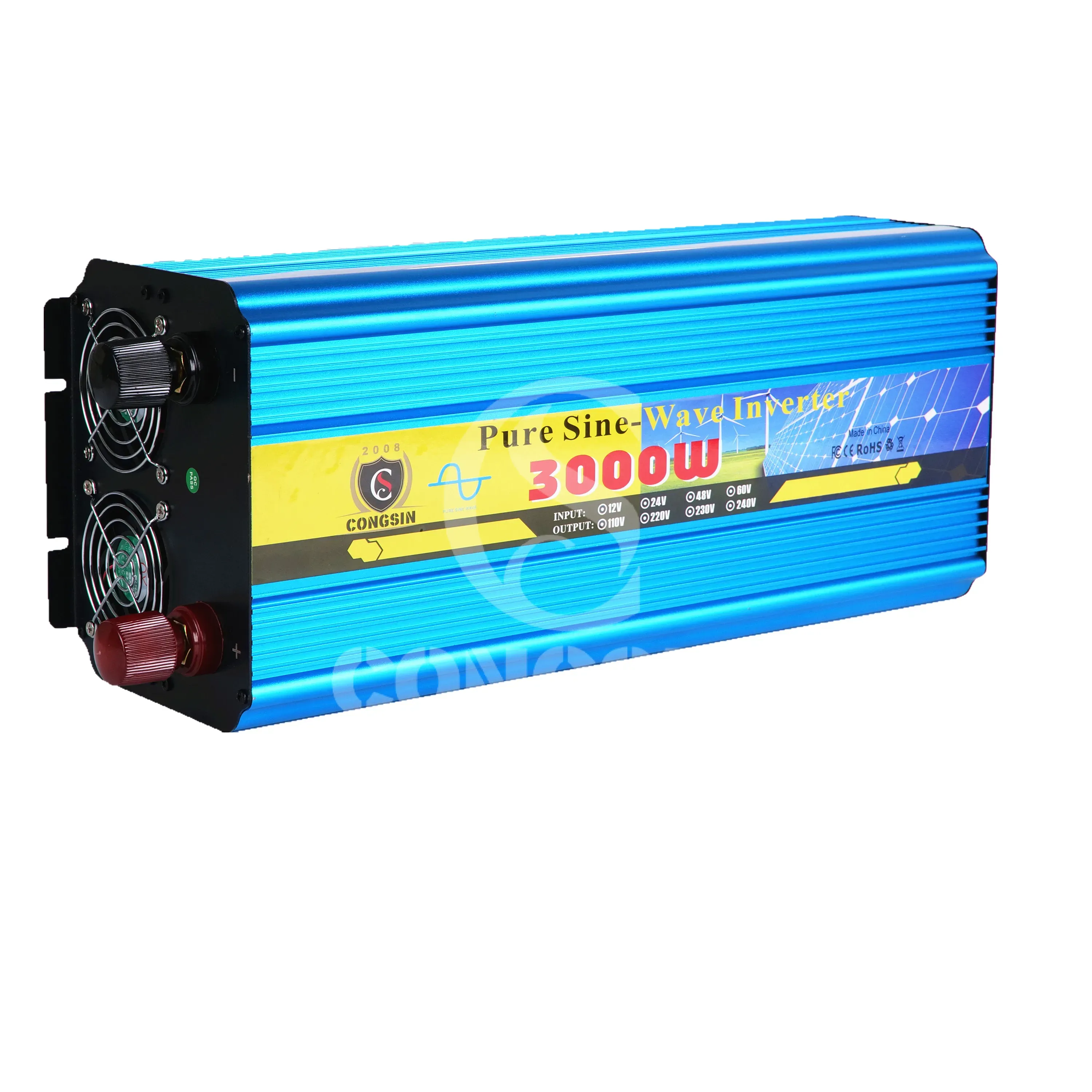
Congsin 3000W LCD Pure Sine Wave Inverter for Home Use Solar Backup Power Inverter Off Grid UPS
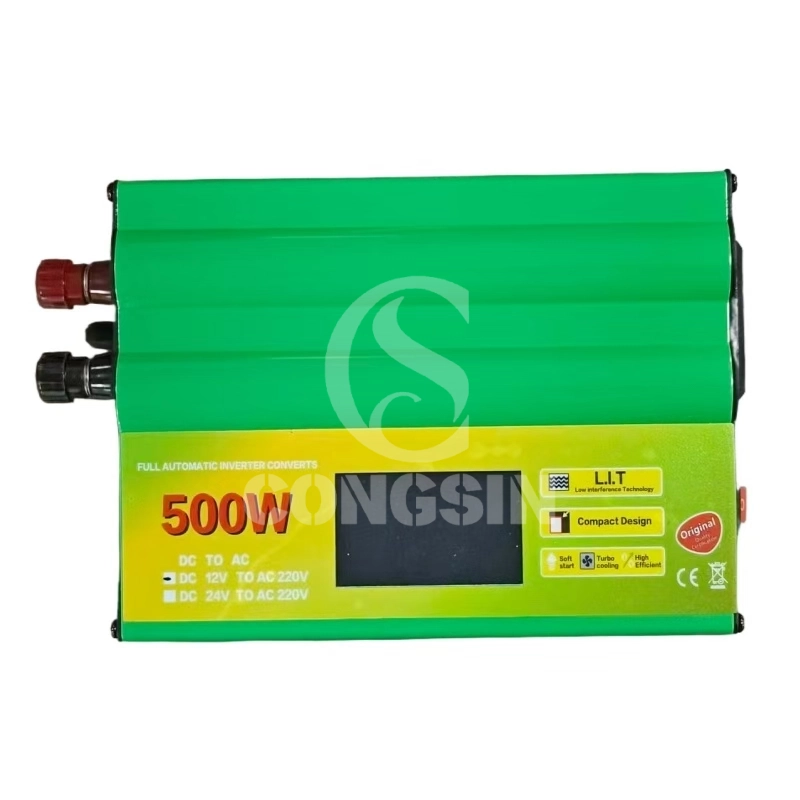
Congsin Modified Sine Wave Inverter 500W 1000W 1500W 12V LED Display Portable for RV Car Solar
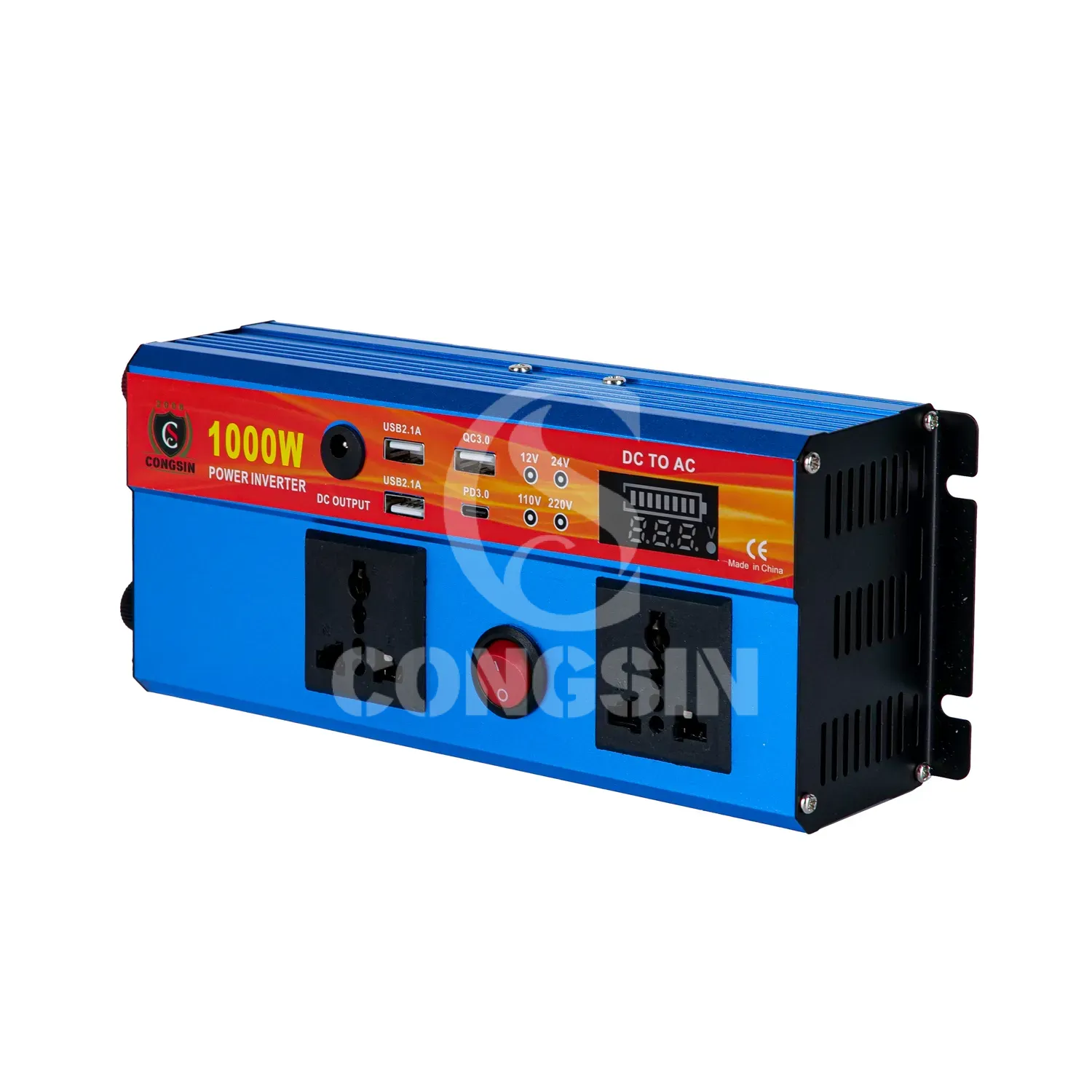
Congsin 1000W modified sine wave inverter with LED display and Type C port car RV power inverter
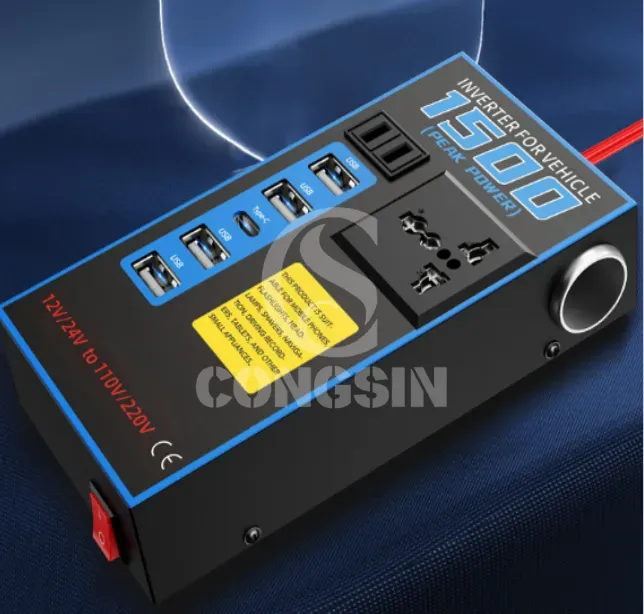
Congsin 1500W Inverter for Vehicle DC 12V/24V to AC 110V/220V with Universal socket Modified Sine Wave

CONGSIN is a trusted OEM factory for power inverters, solar charge controllers, and DC converters. Reliable solutions for global B2B buyers.
 High Quality
 7/24 Service
 Guaranteed Warranty
© 2025 Congsin. All Rights Reserved.